Overview
RGLR Collective wanted to bring our private sector research and strategy experience into government, where we believed more decisions should be informed by the communities they affect. Getting there proved difficult, and other small firms we spoke with faced the same challenge. Winning government contracts often requires experience working with government, making it hard to get started without an existing track record.
Subcontracting with established prime contractors offered a way in, but finding the right partners presented another challenge. Government procurement data is public, yet scattered across portals, PDFs, access requests, and spreadsheets. We couldn’t easily see who was winning relevant work, what might come up for rebid, or where our capabilities could supplement.
I led the product and technical development of Radar to turn that information into actionable opportunities. It launched in August 2026, when we stopped using our outsourced procurement partner, and later expanded into bid qualification and proposal preparation.
Problem
Finding the right opportunities required piecing together information from disconnected sources. Solicitations lived in procurement portals, awards in PDFs, and spending records in separate databases. Even when information was available, connecting it to a specific company or contract required substantial manual research.
We needed more than a list of open bids. Our strategy depended on understanding which prime contractors were winning relevant work, which companies had narrowly lost competitive bids, and when existing contracts might be rebid. That information could help us identify partners who might benefit from our capabilities before the next solicitation opened.
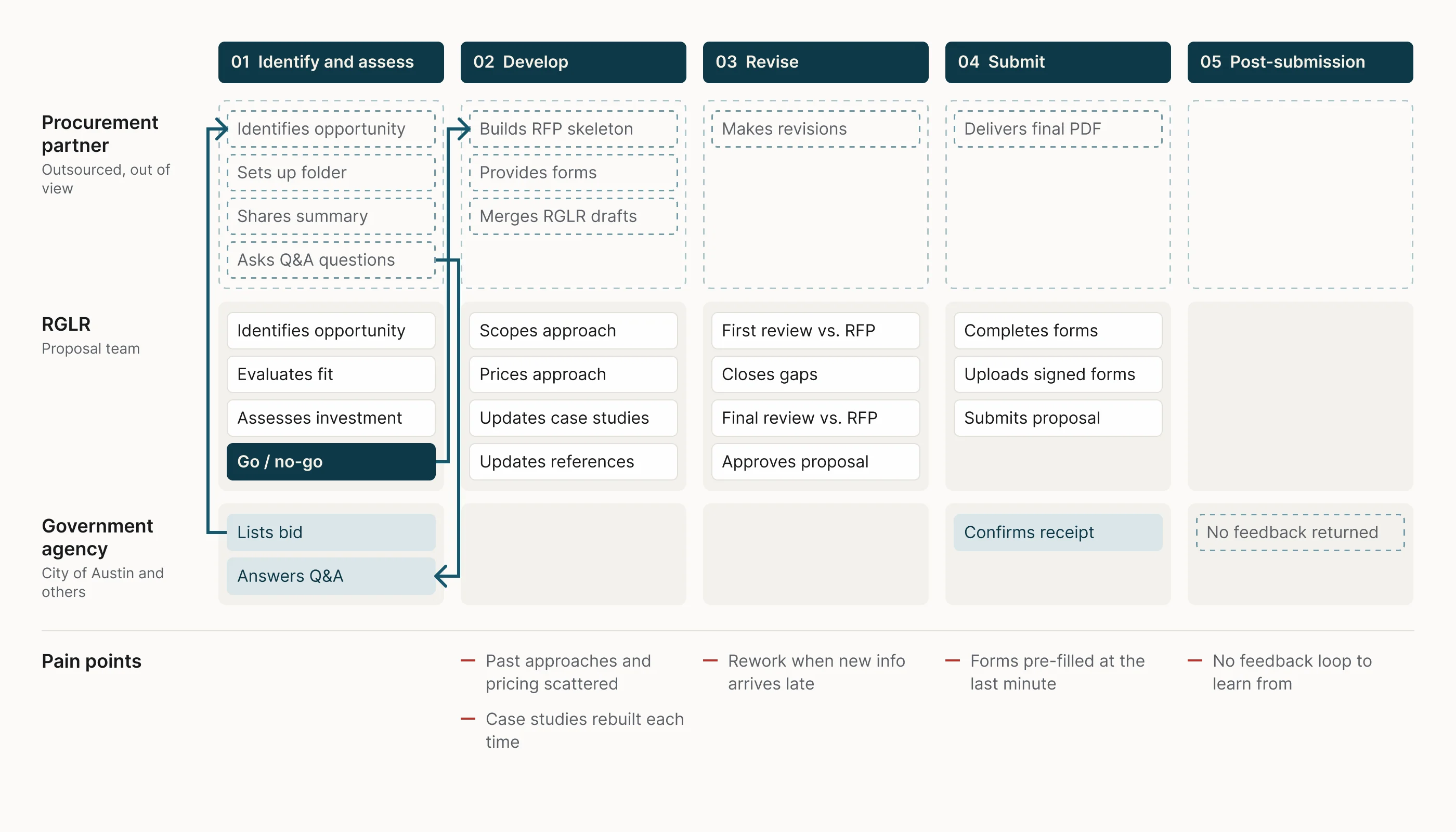
Without a reliable way to connect those records, we were spending time searching for opportunities without knowing whether we were pursuing the right ones. Our team estimated that sourcing, qualifying, and preparing a single RFP response took roughly 50 hours.
Approach
We started by mapping our procurement workflow, from identifying opportunities through submitting proposals. Rather than immediately building software, we recreated the process manually using Perplexity and real government records to understand which questions the available data could answer.
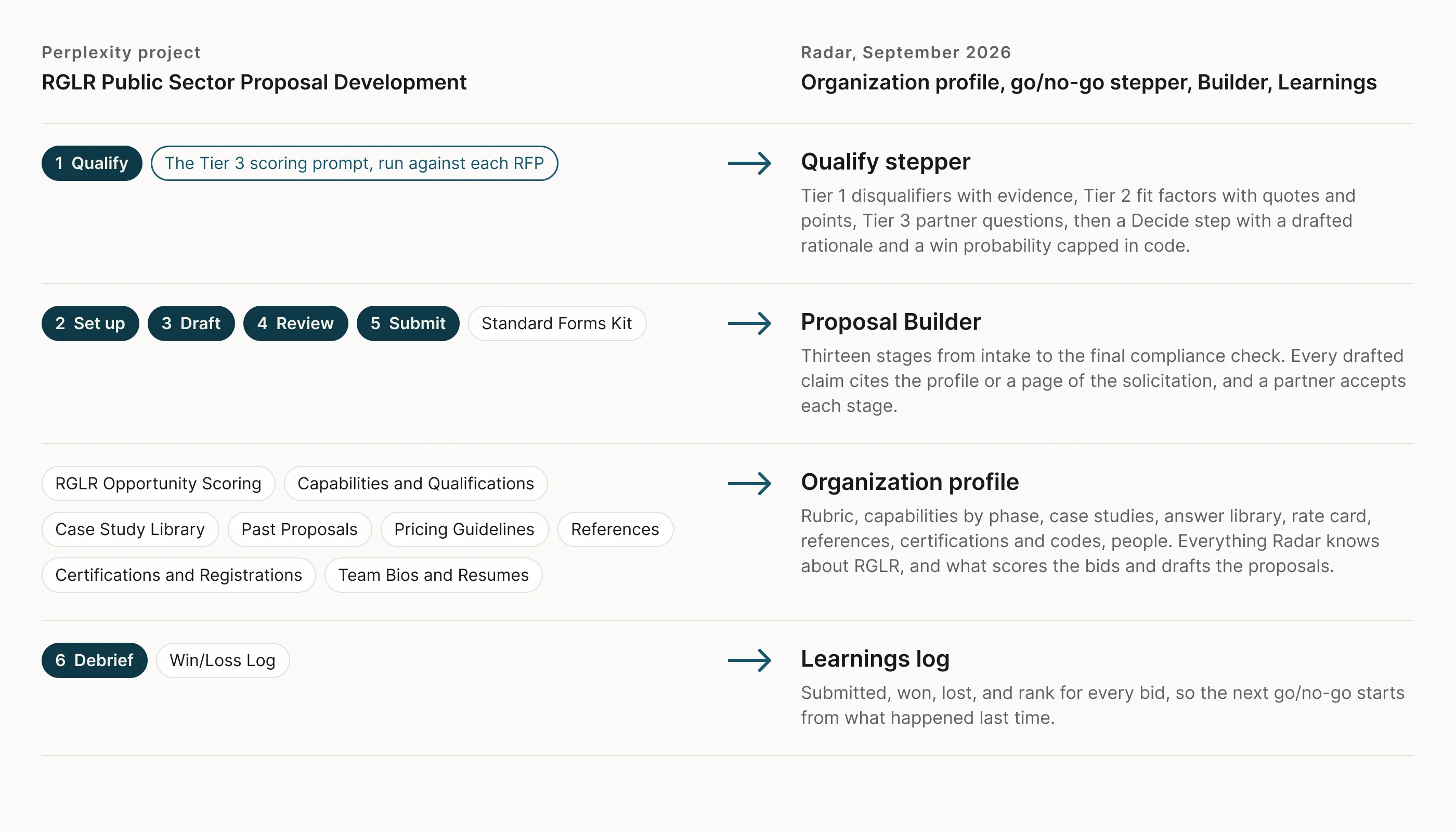
That exploration revealed that the City of Austin published detailed evaluation matrices showing how bidders scored against one another. Combined with contract awards, vendor information, and spending records, these documents offered a way to understand the competitive landscape rather than simply track open opportunities.
The next challenge was technical. We needed to combine disconnected procurement and financial records, match companies across inconsistent data sources, and extract useful information from PDFs. I scoped an initial proof of concept, wrote the specifications, directed AI coding agents through implementation, and audited the results. Once we proved the core approach was feasible, we put Radar into production and continued expanding its capabilities.
Key decisions
1. Use AI for extraction without blindly trusting the results
Government evaluation documents vary considerably in structure, making traditional parsing difficult to maintain. I chose to use Claude to extract information while requiring source evidence and human review for uncertain results. The system initially routes every extraction through review until accuracy testing supports lowering the threshold. This limits automation, but keeps unverified information from influencing business decisions.
2. Prioritize local depth over broad coverage
I focused Radar on Austin and Travis County, where we could combine procurement records, financial information, and approximate company matching to better understand who was winning work and where opportunities might exist. We later discovered broader procurement platforms like Haven, which reinforced our decision to differentiate through local depth. I designed the underlying system to support additional organizations and markets without taking on that complexity at launch.
3. Expand along the workflow, not just the data footprint
Finding opportunities solved only part of our problem. We still needed to decide which ones were worth pursuing and prepare responses efficiently. I prioritized a go/no-go scorecard and proposal builder over expanding geographic coverage so Radar could support more of our existing workflow. This gave us a more useful internal product before attempting to serve a larger market.
Solution
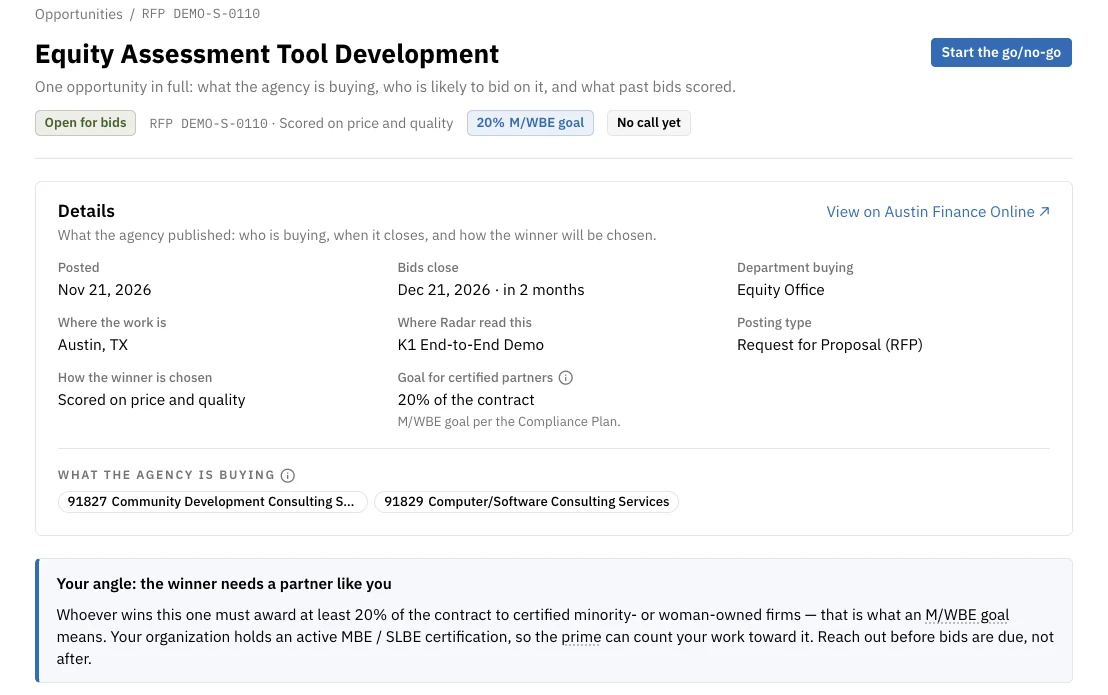
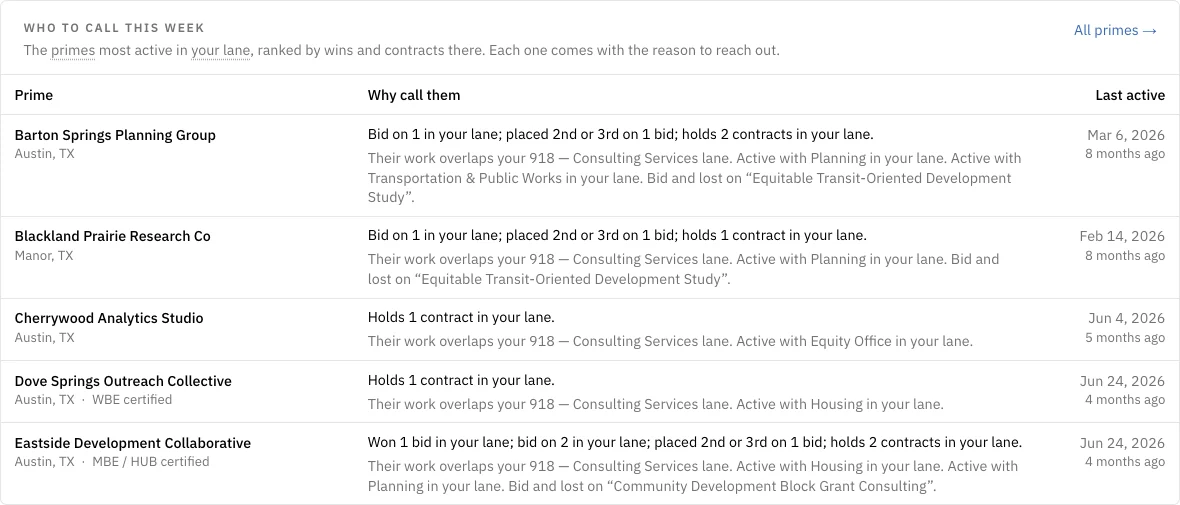
Radar brings together procurement, contract, spending, and vendor records to help us identify potential prime partners and understand why they may be worth contacting. It highlights expiring contracts, competitive bidders, and relevant opportunities while retaining the underlying evidence for review.
The product has since expanded to include a structured go/no-go assessment and a proposal builder that helps carry qualified opportunities through response preparation.
Outcomes
- Brought procurement research in-house. RGLR stopped using its outsourced procurement partner in August 2026, eliminating a service that had cost $1,150 per RFP response.
- Turned a technical proof of concept into an operational tool. Radar launched in August 2026, with go/no-go assessments and proposal preparation added in September.
- Connected more of the procurement workflow. We can now research likely partners, evaluate opportunities, and prepare proposals using a shared system.
- Created a demonstration of our capabilities. We now use Radar in conversations with prospective clients to show how we approach research, automation, and AI-assisted decision-making.
Radar is still in its early stages. We’re using it to pursue opportunities for RGLR while learning which capabilities could help other small firms navigate government contracting.